


110.1 Release Highlights#
Native Rendering of Gaussian Splats#
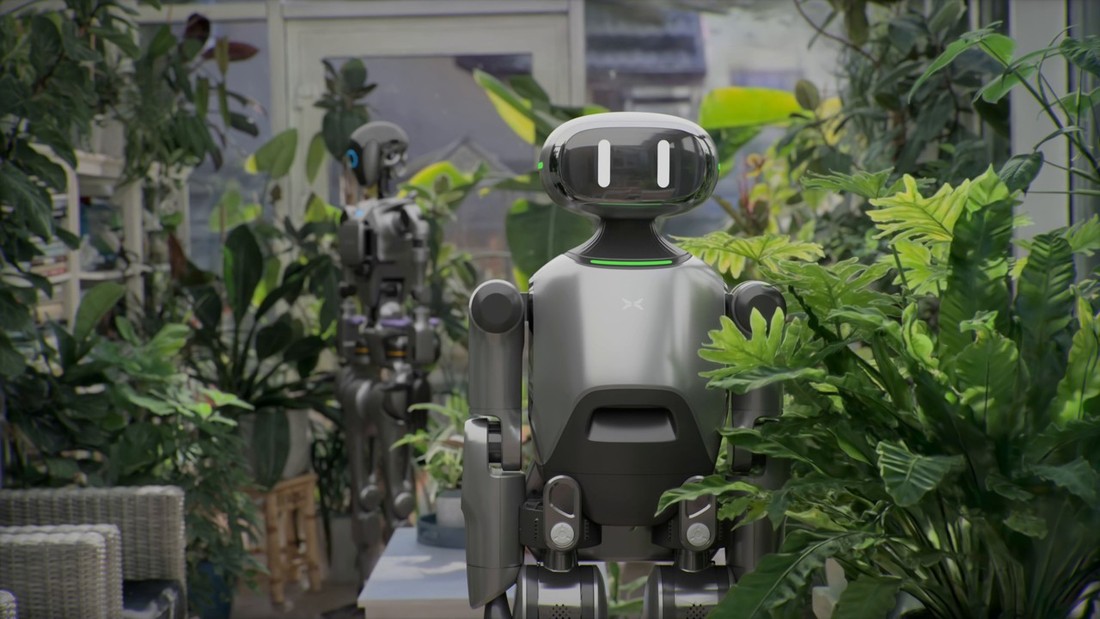
Winter Garden 3D Gaussian Splat rendered together with polygonal robots.#
3D scanning data created and provided by Andrii Shramko, Teleportour (teleportour.com)
Particle Fields are a new geometry type in OpenUSD for rendering 3D Gaussian Splats (3DGS) and other radiance fields such as 3D Gaussian Unscented Transforms (3DGUT).
Omniverse RTX renders these fields natively, with full path-tracing. This means that particle fields can be rendered with all camera types, including defocus and motion blur effects, can cast and receive shadows from other scene objects such as meshes, and are visible in reflections and refractions. This supersedes the previous compositing-based approach to rendering Gaussians and other radiance-field primitives.
RTX Minimal Mode#

Tiled minimal rendering of a robot arm during policy training#
The Minimal render mode provides simple, fast rendering suitable for training-in-the-loop and other workflows where full light transport is not required and achieving the lowest possible latency and highest possible throughput is more important.
Minimal completely disables all indirect light transport and uses only the first distant light source found in the scene, with hard shadows only. Ambient light may also be used for improved visibility.
Added#
GPU Profiler - Complete memory tracking data, including sub-allocations, heap fragmentation, and driver-internal memory, is now shown in the GPU Profiler window.
Lidar - Lidar model now supports memory tracking with RTX.
RTX - Upgraded to
Iray/Neuray/MDL2025.0.5, including bug fixes and support for sheen in RTX RT 2.0.RTX - Ultrasonic Sensor Simulation (USS) parameters can now be updated at runtime without requiring a simulation restart.
RTX - Added a checkbox option to apply dome light after tonemapping in RTX RT2 and RTX PT renderers, allowing the viewport to visually match final image output (PNG, JPG, HDR).
RTX - Gaussian Splatting rendering now caps the number of ray-intersection tests per ray, preventing GPU timeouts (TDR) in scenes with very densely packed Gaussians.
RTX - XR Resample Utilities are now consolidated into the RTX public header, simplifying access for XR developers.
RTX - Updated Aftermath SDK to 2025.5.
RTX - Scene Partitioning now supports light primitives; light picking respects partition boundaries and light geometry instances support the
primvars:omni:scenePartitionattribute.RTX - Added OmniAcoustic sensor schema for ultrasonic sensors.
RTX - Simulated IR sensor now supports distance-based confidence scaling via a configurable effective distance (
L_effective), where confidence falls off as(L_eff / D)²beyond that threshold; an “Enable IR Simulation” toggle allows switching between IR-based and Sobel-only confidence modes.RTX - GPU memory profiler now supports exporting the complete two-level GPU memory map (heaps, sub-allocations, direct graphics and CUDA allocations) to a CSV file, including debug names and scope hierarchies for each allocation.
RTX - GPU memory stats UI now tracks all low-level
carb.graphicsand CUDA allocations, including those that bypass the resource manager, surfacing them under dedicated scopes for improved memory visibility and debugging.SRTX - Universal Scene Subscribe (USS) now supports SRTX workflows, bringing USS up to parity with current SRTX capabilities.
XR - XR runtime service selection UI incorrectly reports a valid runtime as invalid or unavailable when the selected service type is not “cloudxr”.
XR -
OxrSessionManagerincorrectly checks theeventTypefield instead of thepayloadfield in XR opaque data messages, causing payload values to be skipped and potential data corruption.XR - Application crashes when running XR in multi-GPU configurations due to uninitialized
executeWithResultinRenderOp.XR - XR depth AOV is now forced to
XRDepthwhen using the RT2 renderer; legacy depth AOVsGBufferDepthandStableDepthare not supported with RT2 and a warning is issued if an unsupported value is detected.XR - OpenXR stage space handle is now accessible through Python.
XR - New public header
XRRenderingTypes.his available underrendering/include/rtx/xr/, providing common XR rendering types for use in downstream extensions and applications.XR - OpenXR runtime can now operate on a different GPU than the Kit primary GPU, enabling correct swapchain allocation in dual-GPU configurations.
cuda - CUDA toolkit upgraded to 12.8 with CUPTI support for Blackwell GPUs; minimum required drivers are 570.124.06 on Linux and 572.61 on Windows.
omni.kit.profiler - Profiler window now includes a text export option to easily copy and share profiling data.
omni.sensors - Core Framework for Sensor Processing Graphs is now available, enabling functional implementation of core components with end-to-end support for sensor data processing pipelines.
omni.sensors - Radar model updated to support memory tracking with RTX, enabling improved resource monitoring for radar simulation workflows.
omni.sensors - Non-visual sensors now use the RTX Resource Manager for improved resource handling and performance.
Fixed#
RTX - Application crashes on Linux with a SIGSEGV in
rtx::renderer::Context::initializeCommon()during startup when using Blackwell Server Edition GPUs (e.g., RTX PRO 6000).RTX - Memory access violation in
rtx.materialdbcauses application crashes during rapid USD scene loading and unloading with RTX rendering active, affecting both Windows and Linux across DX12 and Vulkan backends.RTX - Heavy artifacts when shading based on animated primvar.
RTX - Updated NavVis IVION pointcloud streaming fetching method for improved performance.
RTX - Potree2 point cloud streamer loads incomplete LOD data.
RTX - MDL shaders fail to load when the asset folder name starts with
Zfollowed by an underscore and hex-like characters (e.g.ZA_5449000177551), as the name is incorrectly interpreted as an MDL module name mangling pattern by the EntityResolver.RTX - Application crashes with a SIGSEGV in
_XSendduring GLX/OpenGL context teardown on Linux shutdown due to an invalid X11 display connection state.RTX -
gpu.foundationplugin crashes with a SIGSEGV during XR integration test initialization due to tuple vector corruption in internal data structures during plugin pre-startup.RTX - GPU pagefault crash occurs when destroying the
omni.kit.scene_view.xrwidget on Windows with D3D12, causing the application to exit with an access violation while render work is still in-flight.RTX - GPU frametime regression in camera benchmark scenarios due to UV projector support overhead.
RTX -
omni.iray.libsfails to load on Ubuntu 25 becauselibneuray.socannot findlibGLU.so.1, which is not included in NVIDIA drivers and requires optional Mesa dev tools to be installed separately.RTX - Radar model produces only a single default point when post-processing is applied on Windows due to an uninitialized variable in the WPM stage.
RTX -
PhysicalLightIlluminantAPIcomputes incorrect XYZ tristimulus values for custom illuminants when no photometric power or illuminance is set, due to a missing Δλ factor in the wavelength integral and an absent photopic scaling factor (K_m=683.002 lm/W).RTX - Semantic data (including bounding box annotations) is missing for prims when light visibility is toggled on/off via the visibility attribute.
RTX - Opening a saved USD file that contains point cloud streaming prims causes errors when not connected to IVION, and reconnecting to IVION after opening does not reload the point cloud streaming data.
RTX - Tiled rendering output is vertically compressed (“squashed”) with incorrect aspect ratio when using the auto-tile resolution setting (0, 0).
RTX -
Composite background after tone mappingsetting incorrectly applies a background composite when background override is set to None, causing an unexpected cyan background when the texture path is invalid, and forces the alpha channel to fully opaque during Movie Capture even whenSave Alphais enabled.RTX - Scene partitioning does not work correctly for scenes containing only foreground geometry, causing all content to render as if scene partitioning is inactive.
RTX - Firefly filtering clamp values are incorrectly set, causing render settings to become unreadable when using Firefly sampling.
RTX - In RTX Interactive mode, sample accumulation stops prematurely the first time Adaptive Sampling is enabled, requiring a disable/re-enable cycle to accumulate the full 512 samples.
RTX -
cutout_opacityanalysis incorrectly returns 0 for OpenPBR PhysicalAI-SimReady-Materials, causing false positive any-hit shader activation and reduced render performance.RTX - Sensor RTX tests produce a different result after octree-based radiance cache.
RTX - Application crashes during indirect diffuse ray generation shader (
IndirectDiffuse.rgs.hlsl) execution, triggered by light cache re-entry scenarios in RTX rendering.RTX - PathTracing payload incorrectly stores packed half-precision values without
asfloatconversion, causing incorrect diffuse evaluation, specular evaluation, and always-zero specular transmittance in path-traced renders.RTX - Glass materials render as black when Ray Guide is enabled in RTX Interactive mode.
RTX - Scenes appear much darker than expected in RTX Interactive mode when Ray Guiding is enabled, even with many accumulated samples.
RTX - SSS materials appear too bright in RTX Real-Time mode when Ray Guide is enabled, even when SSS is disabled in render settings.
RTX - Removing
photometric:powerfrom a light via the Kit UI property panel context menu does not trigger a light update, causing the light brightness to remain driven by the removed attribute instead of falling back tointensity.RTX -
Ghost Factorset to 0 on distant lights does not correctly suppress the light contribution in RT2 and Path Tracing renderers.RTX - RTX renderer on Vulkan supports only half the expected number of unique geometries due to an overly conservative bindless descriptor count limit, preventing large scenes from loading fully.
RTX - Application freezes for up to 60 seconds when playing the timeline with sim-ready assets, caused by dangling references in
GRPCDataStorewhen shard count exceeds 16.RTX - Application crashes on startup when D3D12 validation layers are enabled due to a barrier layout mismatch in
CopyTextureRegion.RTX -
gpu.foundationinitialization produces warnings and errors about IOMMU being enabled on DGX Station GB300 systems.RTX - RTX Rendering: New Invisible Light Behavior worsened the performance and introduced rendering artifacts.
RTX - First batch of render product images appear washed out when a stage is loaded as a sublayer, the timeline is playing, and the render product camera is changed dynamically.
RTX - D3D12 validation error occurs on
GlobalVolumetricEffectsandNoiseVolumeresources, causing crashes when D3D12 validation is enabled on Windows with DX12 renderer.RTX - (XR): Streamed XR visual content appears as noise on Linux systems with two GPUs when the monitor is connected to a GPU other than CUDA device 0.
RTX - Application sometimes crashes when rendering NeRF scenes on Blackwell GPUs with tile rendering enabled.
RTX - Application crashes when selecting Stable ID or Semantic ID debug views on A40 GPUs.
RTX - Reprojection occlusion errors in depth sensor stereo view simulation cause sparse nearby samples to fail to occlude farther samples.
RTX - Matte objects render incorrectly when DLSS is enabled after switching to RTPT rendering.
RTX - vMaterial colors render incorrectly in RTX Path Tracing mode compared to Iray rendering.
RTX - Application crashes when loading certain scenes during RTX raytraced lighting rendering with ground truth resolution settings enabled.
RTX - Skin and fabric materials incorrectly appear specular due to sheen rendering.
RTX - PT AOV Illuminance and PT AOV Luminance contain NaN values when measuring cylindrical light power with a light power meter setup using fisheye spherical projection and path tracing.
RTX - DLSS “FPS Multiplier” setting does not properly update when toggled from “4x” to “Off” and back to “4x”, resulting in approximately 50% of the expected FPS.
RTX - Application crashes with
ERROR_OUT_OF_DEVICE_MEMORYduring scene load on RTX 4090 systems when loading large scenes.RTX -
carb.scenerenderer-rtx.pluginemits a startup warning about acquiring a non-optional plugin interfacecarb::dictionary::ISerializer v1.1that is not listed as a dependency.RTX - Setting an inverted or very high camera clipping range value causes a crash or hang on Windows in RTX ray tracing mode.
RTX - Fractional opacity renders incorrectly in RT1/2 modes, showing white outlines where materials should be transparent.
RTX - Material input hash for MDL materials depends on asset file paths, causing the same material in a different location to produce a different hash and potentially fail cache lookups or reuse.
XR - Application crashes when launching a stereo XR session on a multi-GPU machine using
MinimalRenderer.
Improved#
RTX - Upgraded
Iray/Neuray/MDLto version 2025.0.5.RTX - Verbose logging reduced across GPU and RTX subsystems including
gpu.foundation,rtx.system,rtx.rendergraph,rtx.psodb,rtx.cudann,rtx.omnimodules,gpu.rendergraph,gpu.realm,carb.stats,carb.metrics,carb.imaging, and relatedcarbmodules.omni.iray.libs - Upgraded
OpenSSLfrom 3.5.4 to 3.5.5 inomni.iray.libs.
Known Issues#
RTX -
omni.sensorsplugins emit repeated plugin dependency and interface acquisition warnings in the application log.