


Omniverse Storage Permission Service#
Overview#
This service is the reference implementation of the Omniverse Storage Permission API — the runnable service that implements the published REST and gRPC contracts so other teams can validate integrations and ship compatible alternatives.
Permission Service is a centralized authorization microservice for the NVIDIA Omniverse Storage API ecosystem.
It evaluates access-control decisions on behalf of other services: given a principal (user or service identity),
an action (service-scoped operation), and an optional resource, the service returns an allow, deny, or
skip decision.
Authorization rules are expressed as Cedar policies — a declarative, auditable policy language. The service stores these policies together with service metadata (registered services, their actions, resource types, and evaluation priorities), and uses the metadata to validate incoming requests and drive evaluation behavior.
Table of Contents#
Use Cases#
Unified access control — Omniverse services delegate authorization to a single service instead of implementing their own policy logic. This keeps authorization rules consistent and manageable across the platform.
Fine-grained policies — Cedar policies can match on principal, action, resource, and arbitrary context attributes, enabling rules that range from broad (“allow all reads”) to precise (“allow user X to write document Y”).
Batch authorization — Callers can check multiple action/resource combinations in a single request with configurable short-circuit behavior, reducing round-trips for complex permission checks.
Meta-permissions — When authentication is enabled, the service enforces policies that control who can view or modify policies and service metadata themselves, providing self-protecting administration.
Architecture#
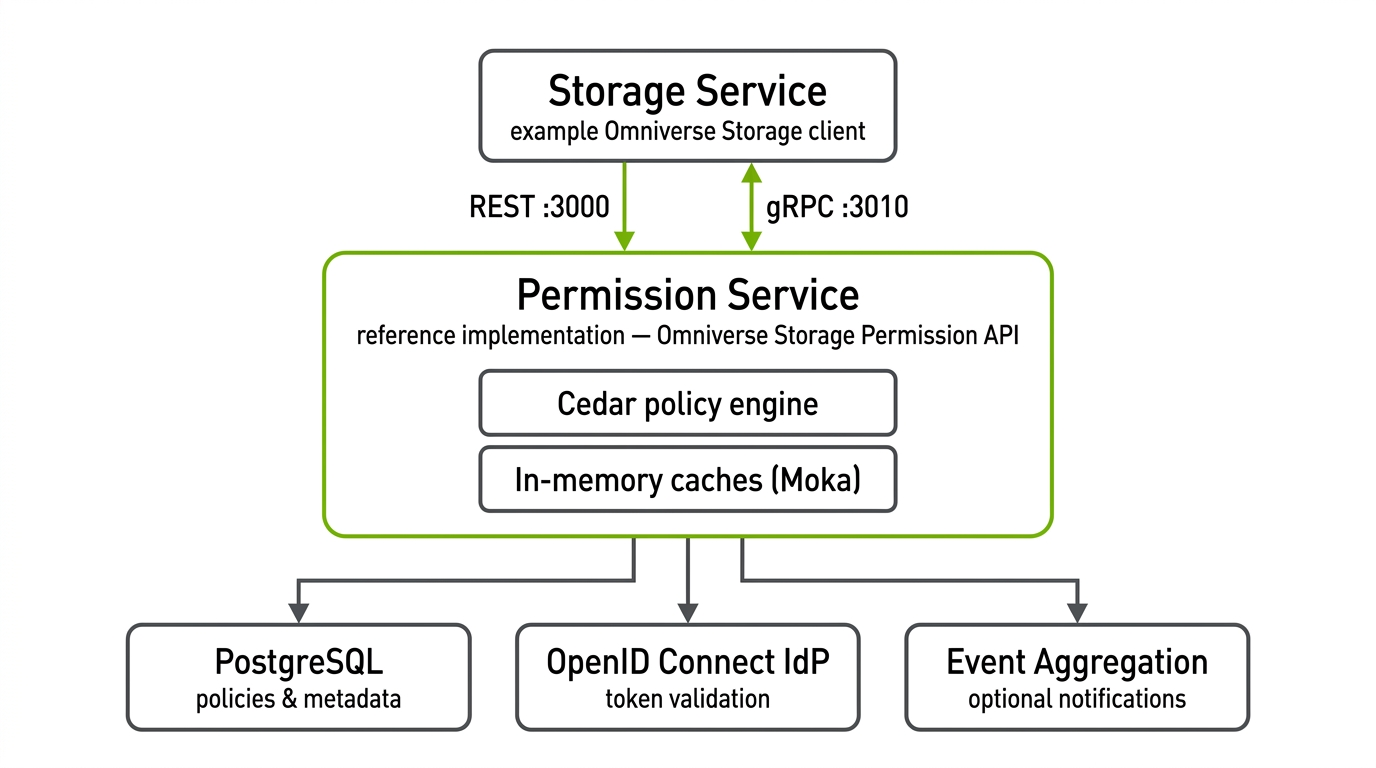
The diagram below uses Storage Service as a concrete example of an Omniverse Storage client that calls Permission Service over REST or gRPC. Other services in the ecosystem follow the same pattern.
Request Flow#
A client such as Storage Service sends an authorization request over REST or gRPC with a principal, action, and optional resource.
If authentication is enabled, the service validates the caller’s Bearer token against the configured OpenID Connect provider using JWKS and/or the userinfo endpoint, depending on how token validation is configured (see OpenID Connect Identity Provider below).
The service resolves service metadata (held in memory) to validate the requested action and determine evaluation priority for the matching resource type.
Relevant Cedar policies are loaded from storage and evaluated by the embedded Cedar engine. Evaluation results may be cached to accelerate repeated checks.
The decision (
allow,deny, orskip) is returned to the caller.
For a detailed walk-through of each stage — authentication, metadata and cache lookups, policy retrieval, and Cedar’s order-grouped evaluation — see How authorization requests are evaluated.
How Other Services Interact with Permission Service#
Calling services integrate through either API:
REST / JSON — Single and batch authorization endpoints with JSON request and response bodies. Interactive API documentation is bundled with the service.
gRPC — Single and batch permission-check RPCs defined in the published API contract; reflection is available for clients that discover services dynamically.
Both APIs accept the same logical inputs: principal, service-scoped action, optional resource, and optional context. Both return a decision with an optional reason.
What Permission Service Interacts With#
External System |
Role |
|---|---|
PostgreSQL |
Read-write storage for policies and service metadata. An alternative config-file mode uses local YAML files as a read-only store (no database required). |
OpenID Connect Identity Provider |
Validates incoming bearer tokens when authentication is enabled. The service loads the provider’s discovery document and then uses JWKS and/or the userinfo endpoint as described below. |
Event Aggregation Service |
Optional. When notifications are enabled, the service publishes permission-change events over gRPC so that downstream services can react to policy updates. See Service notifications. |
OpenTelemetry |
Optional. Metrics and traces can be exported to your observability stack using standard OpenTelemetry exporters. |
OpenID Connect Identity Provider#
When authentication is enabled, Permission Service trusts an OpenID Connect (OIDC) provider discovered at deployment time. Incoming bearer tokens are validated in one of these ways:
JWT with JWKS — For JWT access tokens, the service verifies the signature and claims using the provider’s JWKS publishing endpoint. Keys are cached and refreshed so the IdP can rotate signing material without service restarts.
JWT plus userinfo — The same JWKS verification applies, and the service also calls the OIDC userinfo endpoint with the bearer token to enrich the principal (for example, extra profile claims used in policies or logging).
Opaque tokens via userinfo — For opaque access tokens, the service relies on the userinfo endpoint: the token is accepted when the provider returns a successful response, and claims come from that response.
Validated tokens and principal details may be cached to limit load on the identity provider.
For the Helm values that configure the IdP integration, the three token verification types in detail, and a worked Microsoft Entra ID example, see Authenticating with an OpenID Connect Identity Provider.
Technologies#
Area |
Overview |
|---|---|
Implementation |
Rust binary, built for container deployment |
Policy language |
|
APIs |
HTTPS REST with JSON, gRPC, and interactive OpenAPI-based documentation |
Caching |
In-memory caches for evaluation results, metadata, and auth-related data |
Durable storage |
PostgreSQL, or file-backed YAML for read-only deployments |
Observability |
OpenTelemetry for metrics and traces |
Contents:
- Permission Service Configuration
- Database Configuration
- Authenticating with an OpenID Connect Identity Provider
- Writing Cedar policies for Permission Service
- Managing policies through the REST API
- Managing service metadata through the REST API
- How authorization requests are evaluated
- Diagnostics API
- Service notifications
- Observability
- Permission Web UI
See also#
The Omniverse Storage Permission API specification (REST and gRPC) is documented separately; this service tracks that contract as its reference implementation.