


Omniverse Storage Thumbnail Service#
Overview#
This service is the reference implementation of the Omniverse Storage Thumbnail API — the runnable service that implements the published REST and gRPC contracts so other teams can validate integrations and ship compatible alternatives.
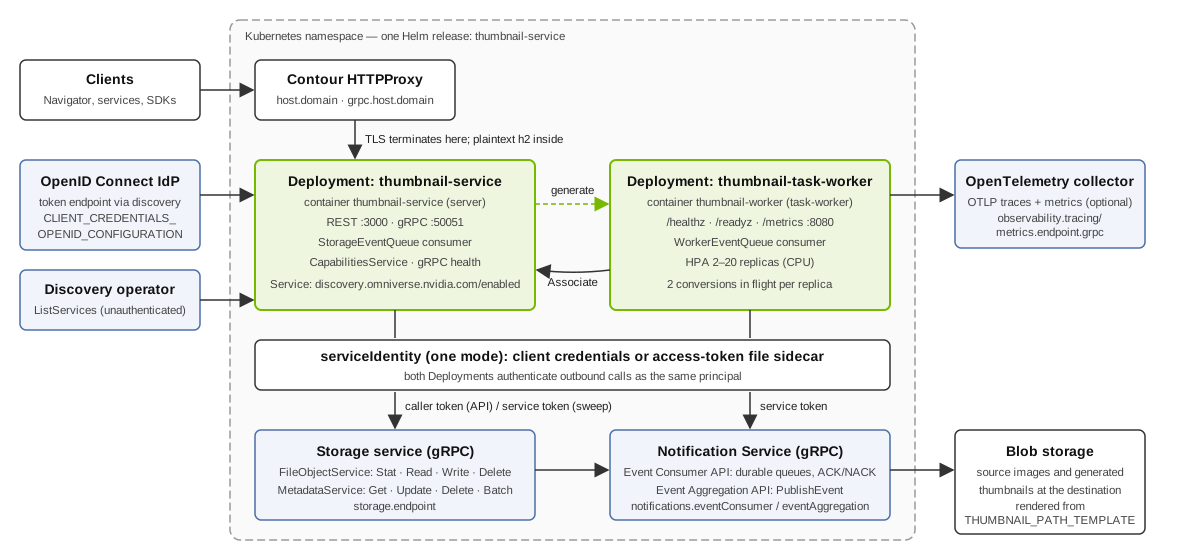
Thumbnail Service generates preview images for files stored in the Omniverse Storage service and records the association between each source file and its thumbnails. It ships as two cooperating deployables from one Helm chart:
Thumbnail Service (the orchestrator) exposes the REST and gRPC APIs, consumes storage lifecycle events, decides what to generate and where each thumbnail is written, and is the single authority for association metadata.
Thumbnail task-worker performs the image conversion: it consumes generation work from its own durable queue, downloads the source, converts it, uploads the thumbnail, and asks the orchestrator to record the association.
Both components authenticate outbound calls with one shared service identity issued by an OpenID Connect identity provider, and both exchange work exclusively through durable queues on the Omniverse Notification Service.
Table of Contents#
Use Cases#
Automatic previews — a durable subscription to
omni.storage.createdevents turns every eligible image landing in a watched storage container into one thumbnail per configured size, with no client call.On-demand generation — clients call
POST /v1alpha/thumbnailsorCreateThumbnailsto request thumbnails for a specific source with their own specifications, and receive per-specification acceptance.Registering pre-generated thumbnails — a
MANUALspecification lets a caller associate a thumbnail it produced itself, without any conversion.Discovering previews —
GET /v1alpha/thumbnailsandGetThumbnailslist the thumbnails associated with a file or folder, filtered by size, format, or transform, so clients render previews without deriving storage paths.Lifecycle hygiene — when a source is deleted from storage, every association it carried is removed and the service-generated blobs are deleted; caller-owned thumbnails are left alone.
Architecture#
The diagram below shows the two Deployments rendered by the Helm chart, the two durable Notification queues that connect them, and the external services each one calls.
Request Flow#
A file is created in a watched storage container and the Storage service publishes
omni.storage.created. Thumbnail Service receives it from StorageEventQueue and checks eligibility: the address must name a file with a supported image extension, and it must not be a thumbnail the service itself generated.Alternatively, a client calls
POST /v1alpha/thumbnails(or gRPCCreateThumbnails) with aresource_address. The service validates the request, then resolves the source’sresource_identitywith a storageStatusing the caller’s bearer token.For every requested size (the caller’s specifications, or one per configured
THUMBNAIL_SIZESentry) the service resolves the exact output address fromTHUMBNAIL_PATH_TEMPLATEand publishes oneomni.thumbnail.generateevent. Acknowledging the storage event means the work was durably published, not that a thumbnail exists.Thumbnail task-worker consumes the event from WorkerEventQueue, downloads the source, converts it inside configured memory bounds, uploads the thumbnail to exactly the address it was given, and calls
AssociateThumbnailon the orchestrator over gRPC.The orchestrator writes the association metadata to the Storage service — one key on the source, one on the thumbnail — and publishes
omni.thumbnail.associatedso downstream consumers can react.Clients read associations back with
GET /v1alpha/thumbnails; a lateromni.storage.deletedevent sweeps them away again.
For the eligibility rules and acknowledgement semantics of step 1 see Storage event consumption; for steps 4–5 see Thumbnail generation worker and Association metadata and queries.
How Other Services Interact with Thumbnail Service#
Calling services integrate through either API:
REST / JSON —
POSTandGETon/v1alpha/thumbnailsfor generation and lookup,POSTandDELETEon/v1alpha/associationsfor registering and removing associations. Interactive API documentation is bundled with the service at/swagger-ui.gRPC —
CreateThumbnails,GetThumbnails,AssociateThumbnail, andDisassociateThumbnailonnvidia.omniverse.thumbnail.v1alpha.ThumbnailService; reflection is available for clients that discover services dynamically.
Both APIs accept the same logical inputs and share one validation path, so a request that is legal on one
transport is legal on the other. Callers present an Authorization: Bearer <token> header (gRPC metadata for
the RPCs); the service checks that a token is present and forwards it to the Storage service, whose permission
check is the authorization decision.
What Thumbnail Service Interacts With#
External System |
Role |
|---|---|
Storage service |
Source of truth for files and metadata. The orchestrator calls |
Notification Service — Event Consumer API |
Hosts the two durable queues. Each component provisions its own queue at startup (ensure-exists) and consumes with explicit acknowledgements; retryable failures are negatively acknowledged and redelivered. |
Notification Service — Event Aggregation API |
Receives every event the orchestrator publishes: |
OpenID Connect Identity Provider |
Issues the bearer token both components present on outbound calls, either exchanged in-process with client credentials or provisioned into a shared file by a sidecar. See Authenticating with an OpenID Connect Identity Provider. |
Discovery operator |
Learns which APIs this deployment serves by calling the unauthenticated |
OpenTelemetry |
Optional. Metrics, traces, and structured logs can be exported to your observability stack. See Observability. |
Two durable queues, two acknowledgement domains#
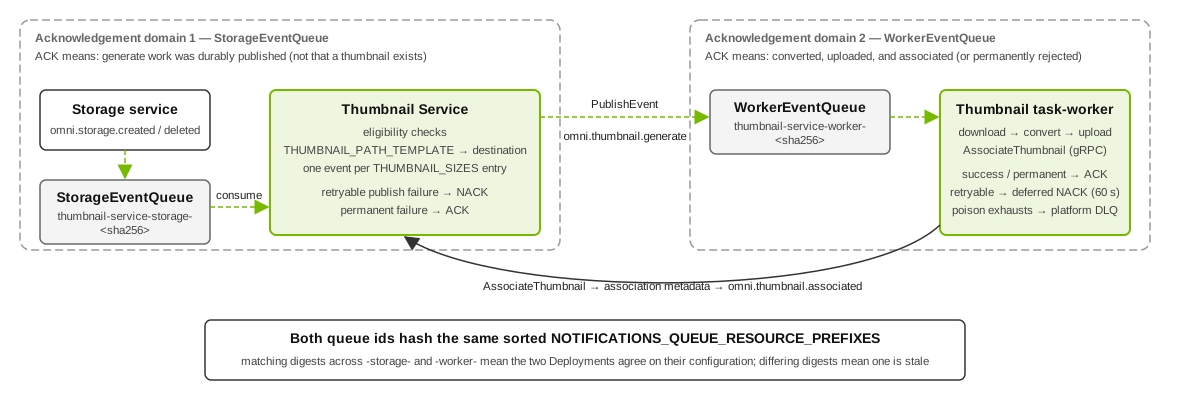
Thumbnail work crosses the Notification Service twice, on two separate durable queues with two distinct ids. This is the single most important thing to understand before operating the service.
StorageEventQueue |
WorkerEventQueue |
|
|---|---|---|
Owner |
orchestrator |
task-worker |
Event types |
|
|
Queue id |
|
|
Filters |
one greedy prefix per watched container |
one greedy prefix per watched container |
An acknowledgement means |
the generate work was durably published |
the thumbnail was converted, uploaded, and associated |
Both ids hash the same sorted set of NOTIFICATIONS_QUEUE_RESOURCE_PREFIXES, so for one configuration they end
in the same digest and differ only in the -storage- / -worker- label. Matching digests in a queue
listing mean the two components agree on their prefixes; differing digests mean one of them is stale. See
Durable queue self-provisioning.
Technologies#
Area |
Overview |
|---|---|
Implementation |
Two cooperating processes ( |
APIs |
HTTP REST with JSON (OpenAPI 3.1 and Swagger UI bundled), gRPC with reflection and the standard health service |
Work distribution |
Durable Notification Service queues with explicit acknowledgements and negative acknowledgements; no broker or database of its own |
Image processing |
Built-in decoders and encoders for JPEG, PNG, GIF, BMP, TIFF, ICO, and WebP input and JPEG, PNG, GIF, and WebP output, with memory bounds enforced before allocation |
Durable state |
None owned by the service — associations live as metadata in the Storage service, thumbnails as blobs |
Observability |
OpenTelemetry metrics and traces over OTLP, W3C trace context end to end, structured JSON logs; a Prometheus text endpoint on the worker |
Contents:
- Thumbnail Service Configuration
- Environment configuration reference
- Authenticating with an OpenID Connect Identity Provider
- Thumbnail destination path template
- Storage event consumption
- Thumbnail generation worker
- Association metadata and queries
- Service notifications
- Observability
- Conformance and smoke tests
- Troubleshooting
See also#
The Omniverse Storage Thumbnail API specification (REST and gRPC) is documented separately; this service tracks that contract as its reference implementation.